Tuesday, September 1, 2015

Human Rights Buy-In

Throughout many conversations with many people in the Lutheran Church of Colombia (IELCO), all from various backgrounds and differing ideas and attitudes, I have learned a few things about how to best accompany the church from the point of view of the human rights program. I have learned that without massive buy-in and without the committed support of church members and pastors, the program will struggle to provide IELCO all that it is capable of.

Because Colombia has a history of holding human rights language in suspicion (due to ideological posturing and the armed conflict), the acceptance of human rights within the population, including the church, is not guaranteed. This means the first step for me in the human rights program is to gain the confidence of the members, leaders and pastors of the church. Not only gaining their confidence but also ensuring that the program is theirs, and encourages their involvement, their leadership and their guidance.

After my first year working in this capacity in Colombia, I had a chance to put the confidence in the human rights program to the test. DIPaz (Dialogo Intereclesial por la paz; Inter-church Dialogue for Peace), which the IELCO is a member, finished its verification of the FARC’s (Revolutionary Armed Forces of Colombia) month of a unilateral ceasefire. This verification was asked for by the FARC with the government’s full knowledge. After seeing that with this unilateral ceasefire, Colombia experienced it’s least violent month in the last forty years, DIPaz wrote a letter to the government and to the FARC leaders urging them to continue the ceasefire and the de-escalation of hostilities.

This letter was opened for signatures from all those members of DIPaz, as well as international supporters of the work of DIPaz. I sent the letter to every pastor of IELCO to see who would sign their name to this important call to strengthen the peace process. An overwhelming response came in with a little over half of all pastors of IELCO signing this letter. This came in as quite an affirmation of the human rights program, and the trust I have been gaining.

As we are looking into the year ahead, and planning the activities of the program, this affirmation has been very inspiring!

In terms of the FARC’s ceasefire, after the first month, they announced that they will now extend their unilateral ceasefire indefinitely, with the hopes that the government will reciprocate. Here is the letter DIPaz wrote (translated in English) for the verification of this first month and the call to continue finding paths towards peace.

Tuesday, August 11, 2015

ProFILE, retreat # 2

To keep with the same tradition of photo-blog for the ProFILE retreats, this blog is also a photo story of the second leadership retreat. I blogged about the first ProFILE retreat here. These are all photos that I took over the weekend. We had a good group again, and have all the congregations in the country represented except 4 and many of the mission congregations!

This was the ice-breaker activity. This activity was one of mine to plan for the weekend. Since this group was almost all the same people from the first retreat, the activity was to introduce someone else. I passed around everyone's name-tags to the wrong person, and they took turns introducing the person whose name tag they had. Here is Christian (left) introducing Julian (right). 


The theme for this leadership retreat was Lutheran confessional. Before the retreat we spent a lot of time creating a game incorporating Lutheran Theology, Lutheran history and fun. The idea was to create an environment where people could learn as well has have fun, and help people to understand the depth of the theology, Martin Luther, and history of IELCO. Here is one of the group playing, left to right, Sonia, Nancy, Carolina, Martin (the guest presenter from Germany), Mauricio, and Abelardo. 

Here is Martin Hoffmann leading a conversation about Lutheran confessional.The group was very interested and took many notes. I think he gave them lots to think about, what it means to be a leader for the church, the leader's role, what isn't the leader's role, etc.  

After the last retreat we gave all of the participants homework, to replicate the first retreat (or a part of it) in their own congregations. Each church had to come to this retreat with a presentation of what they had done, and how it had gone. It was really fun for me to see the activities that we had planned last time being replicated all over the country! In this picture is Carolina (left) and July (right). They are both from the same region but different churches, their churches are about 5 hours apart. However, Carolina is the only one from her church participating in the program, so July went to Carolina's church to help her lead the training there. Both of these young women are 17 (wow), and extremely dedicated leaders within their congregations. 

During the presentations the rest of the group was in charge of giving feedback - one positive comment, and one thing they could improve on. We color coded everything to make it easier (and also prettier). Each church will now bring these suggestions back to their own churches and, hopefully, improve their leadership. Upper left is Enrique and Tatiana from Emaus in Medellin, and bottom right is Sergio and Mauricio from Vida Nueva in Bogota. 

Another activity we did was decorate the Luther Rose. Everyone go one of these pieces of paper along with whatever craft supplies we could dig up from around the office. This was a good mental break after some intense sessions. As you can see from the photos everyone got really into the decorating. Top row (left to right): Maria del Pilar, Maritza. Middle (left to right): German, Henry. Bottom (left to right): Carolina and Julian. 

Here are the leaders of ProFILE after the second retreat. This retreat was in the region of Boyaca, at a retreat center just outside of Paipa. Everyone looks happy and a little tired. It was another good retreat. I continue to be excited about the future of this church, especially in the hands of these amazing people! 

Tuesday, August 4, 2015

Small Acts of Solidarity

"Long live peace"
Photo credit - Washington Office on Latin America, wola.org
On July 20th the FARC (Revolutionary Armed Forces of Colombia) implemented its second unilateral ceasefire of the year, with the government offering to de-escalate its violence as well. These are positive steps for the public confidence in the peace talks, as well as the lives that will be saved while the ceasefire lasts and de-escalation of violence is realized.

After the last unilateral ceasefire offered by the FARC (December 2014 to April 2015) was abandoned and the conflict reached its most violent period since the beginning of the peace talks (2012), the public trust that a final peace will be agreed on has reached a dramatic low. With these new commitments to de-escalate the armed conflict, re-building the public confidence will be crucial.

In the more than 50 years of the conflict between the FARC and the government of Colombia, it is estimated that over 260,000 people have been killed (the majority of them civilians) and over 6 million have been displaced (the majority of them rural poor, indigenous or Afro-Colombians).  Those most vulnerable to suffer from the conflict are those already most marginalized economically and politically.

This is a critical moment for the peace process in Colombia. The Latin American Working Group has issued an urgent call to action for all American citizens. A dear colleague letter addressed to Secretary of State John Kerry and to US Special Envoy to Colombia Bernard Aronson has been sent by Representative James McGovern in support of the peace talks. This action urges all representatives to sign the letter and support peace for the people of Colombia.

Grafiti art, promoting peace in Colombia. In blue says: "The peace
demands four essential components:truth, justice, love and freedom"
Photo credit - Katie
The letter urges for the negotiations between the Colombian government and the FARC to be inclusive of those vulnerable groups of Colombian society most affected by the conflict, especially rural, indigenous and Afro-Colombian communities. The letter also urges for any peace accords reached to center on the needs of victims and contribute to ending Colombia's history of impunity. 

Strong support from the US government would make a significant impact on the strength of the peace process. And, as the letter states:

It is crucial for the U.S. government to take this historic opportunity to back peace for the longest running conflict in the Americas. Since the war began five decades ago, Colombians have been subjected to forced displacements, widespread massacres, kidnappings, threats against human rights activists, and the social exclusion of indigenous and Afro-Colombian communities.

Just before the unilateral ceasefire started on the 20th of July, DIPaz (Inter-Church Dialogue for Peace in Colombia), which the Lutheran Church of Colombia is a member of, issued a letter to government and FARC representatives calling for a bilateral ceasefire, stating (translated from Spanish):

We cannot help but express our sorrow, as Christians and as human beings, in response to the deaths that continue taking place in Colombia, which could have been avoided with an agreement for a bilateral ceasefire. All lives are sacred, as Pope Francis reminds us in his recent Enclyclical Laudato Si': those of the civilian population, those in nature, those of soldiers and police officers, and those of the guerrillas. The government should change their position from refusing an agreement for a bilateral ceasefire to a position in favor of life and the greater legitimacy of the continued dialogues. The FARC should return to their willingness and decision to maintain a ceasefire. We call, with the power of the Gospel, for both parties to commit to a bilateral ceasefire and the de-escalation of the confrontation.

Photo credit - Washington Office on Latin America, wola.org
As a non-Colombian working on issues surrounding the long-lasting armed conflict of Colombia, the relationship of solidarity is central. This solidarity, as discussed in the ELCA's model of accompaniment, means that I am learning to walk hand in hand with my Colombian counterparts regarding peace, justice and human rights; it means to be in a committed relationship of mutuality, collaboration and respect across economic, national and social boundaries.

While the US government has impacted the conflict in Colombia in strong and various ways, and has massive influence over the Colombian government, the people of Colombia do not elect our leaders in the US. The solidarity between the church in the US and the church in Colombia must be centered on choosing life, on choosing peace for our brothers and sisters, and on the knowledge that our humanity is intertwined and inseparable from theirs. Urging our elected leaders to promote peace and justice for those Colombians suffering from the loss of homes and livelihoods, of family members and friends, as well as daily insecurity, among others, is a small act, a small way of  constructing and maintaining the relationship of solidarity.

P.S. If you haven't already, please don't forget to subscribe to our blog (in the upper right corner) - thank you for reading!


Tuesday, July 28, 2015

Mutual Learning and Accompaniment

Map from BBC News.
In the Southwest Colombian department of Nariño (on the border with Ecuador), the Lutheran Church is accompanying the indigenous Pasto community in an environmental/food security project. The project involves supporting the construction and maintenance of organic gardens as well as farming cuy (guinea pigs) [same concept as fish farms], which are a delicacy for the indigenous peoples in this region.


We visited all the participants gardens to discuss what they were leaning,
what challenges they were facing,
and how the project could be strengthened. 
(Photo credit -Curtis Kline)
A similar project exists in Boyaca (a department of Colombia, north of Bogota, and fish farming in place of cuy) with non-indigenous peoples. The idea is that these two very different communities will visit each other’s projects, share experiences, knowledge about ecologies and food/environmental issues, to learn from and share with each other, strengthening both projects.

The indigenous Pastos invited me to come and hold a workshop about the international system of protecting and promoting the rights of indigenous peoples, as well as experiences other indigenous communities have had regarding the protection of their rights. This past week, July 21-25, I was able to go visit the environmental project, hold the workshop and get to know many of the leaders of the community.

Beginning my presentation with participants from the
environmental project and various community leaders.
(Photo credit - Jairo Suarez) 
A view of the participants of the workshop.
(Photo credit - Jairo Suarez)

The community received the issues well, and invited me and the human rights program of the Lutheran church to continue in accompaniment with them around issues of the rights of indigenous peoples. We identified several vulnerable areas to focus on regarding the rights of the indigenous Pastos, ranging from the recuperation of their traditional language to protecting their environment against mining incursions.

After learning what rights are protected internationally as well
as in the Colombian constitution, the participants analyzed the areas
where the protection of these rights is not being implemented.
(Photo credit - Jairo Suarez) 
The possibility of replicating the workshop, as well as future activities with this community is exciting. The indigenous Pasto women are very involved with the association of indigenous women of Nariño, and could potentially involved four other indigenous nations in these workshops and discussion on how to protect their rights. 

The opportunities are numerous and exciting, especially the opening of space for intercultural dialogue, the learning of different ways of understanding the world, and the building of relationships of solidarity.

Above is a music video from a group of talented Pasto youth musicians. The video shows various important components to the culture, as well as many beautiful landscapes of their territory. 

P.S. Please consider subscribing to our blog (upper left corner). Once you subscribe, don't forget to respond to the confirmation email. Thanks for reading!

Tuesday, July 21, 2015

Two dollars and fifty cents

Karol styling her model's hair (photo credit - Katie)
One of the programs I accompany is a girl's (pre-teen/teen) program in the south of Bogota, in a barrio called Caracoli. The program is new this year, 'Proyectándome a un futuro'; there isn't a good translation of the name into English, but more or less it's projecting/giving myself a future. The idea behind the program is to help the young woman of this very impoverished community (one of the most impoverished in Bogota) see the options for their future. During July, many of the schools have a short break (the schools in Colombia operate on the calendar year with a few shorter breaks throughout the year). One of the goals of 'Proyectándome a un futuro' is to give the young women (ages 11-16) some job skills, so they can have enough money to stay in school and buy notebooks, uniforms, and help out their families, as well as understand a little more about business and money management. During this break 'Proyectándome a un futuro' brought in a woman to teach the girls some hairstyles. This was a 6 day class, spread over two weeks. The girls that completed the whole course got a certificate. Every day for the class the girls needed to bring their 'model', a younger girl who they could practice and learn on (bonus for their models was a new - free hairstyle everyday). I was a 'model' on Saturday for Tatiana. As you can can see from the collage below, these are very intricate hairstyles. Each girl was given their hair-styling kit, which included a book of all the different hairstyles they learned. Saturday their task was to let their model go through the book and pick whatever hairstyle they wanted. Tatiana, seemingly effortlessly did this style to my hair (I asked her to pick the style she thought would look the best, and be the best for an adult).

Tatiana styling my hair (photo credit all - Ana Medivelso) 
This last Saturday was the last day of class, the room was full for the award ceremony and cake that followed. During the ceremony one of the girls shared her story that already (before she had even finished the class) a neighbor girl came to her to have her hair done. A hairstyle like these cost about 5,000 Colombian Pesos (or $2.50). This may not seem like much, however this is considerable (especially when you consider the age of these girls) and that this money will definitely help out her family. Her story (I hope) will also inspire the other girls and definitely affirmed the skills they were being certified for. Hairstyles like these are popular, and with the certificates, these girls will have the opportunity to work and earn a little money.

We also used this class as an outreach tool for the community. We opened the class up to the girls in the community who are not yet a part of 'Proyectándome a un futuro'. There was a huge response, and many of the girls promised to come back and become an active part of the program. I am excited for the weeks to come to see how the 'Proyectándome a un futuro' grows, and how these girls continue to use their new skills.
The girls with their certificates (Photo credit - Leah Johnson) 

P.S. Please consider subscribing to our blog (upper left corner). Once you subscribe, don't forget to respond to the confirmation email. Thanks for reading!

Tuesday, July 14, 2015

Trinidad: Misión en el camino (Mission Trip)

Us with painted faces, left to right, Adi, Ida, and me (photo credit, selfie)
I just got back from another Misión en el camino (in April I wrote about a  Misión en el camino to El Cocuy). These trips are designed for a small group to go to another church to support them and their different ministries for a week. Last week was a very full week. Four of us from Bogota went to Trinidad, about a 13 hour bus ride. We accompanied the woman's group, children's group (similar to Sunday to School), youth group, we lead an activity at the CasaDia (day home for elderly), did some painting and yard work, and made several house visits to members of the congregations. From the moment we got there until the moment we left, we were busy. It is almost impossible, at least for me, to write about the whole week (well), so there are a few highlights I would like to share.
Most of the children with their crafts (photo credit - Katie)

The first is the Sunday morning. Sunday morning, before worship, we had a party for the children of the church and children in the community. These are parties that we have encouraged every congregation to have this year as a way to grow their children's ministry. Part of my role with the Christian Formation has been to accompany and support/help with these parties. We gave all the formation leaders of each congregation ideas for the party including a skit idea, games ideas, etc. So for this party (and other ones I have been at, we of course follow our own plan). We painted our faces before hand so it would feel more festive, and for a skit we did for the kids. During the fiesta (party) for the kids we had games. Adi lead the games and had all the kids laughing, involved, and having a great time in about three minutes. We did a skit, which was also a new type of Spanish for me - improv acting. We did a craft and then had a snack. After the snack we took our group picture, and then we gave everyone their party favors. I always enjoy the energy and life that children have.

Above: Antonio with his chinchorro (photo credit - Katie)
Below: A close-up of the chinchorro (photo credit - Katie). 
Another activity we participated in was at the CasaDia, day home for the elderly. We lead an activity called memory boxes. That went okay, but what really impacted me about the CasaDia was the conversations I had after our activity. In a large open room they have looms set up for the participants to make chinchorros (like hammocks, but a different material, for different climate). The chinchorros are all handmade, they are absolutely a labor of love. I sat and talked with Antonio. He showed me how the chinchorros are made, the different weaving patterns, and then we talked about his life. He had incredible stories to tell me about the different places he has lived, as well how the conflict in Colombia has affected his life. In one moment during our conversation, Antonio asked me what I thought of Trinidad, and mentioned it being "hot", I agreed, as the weather in Trinidad is hot, but that was okay with me, I liked the heat. He kind of looked at me and said no, hot with guerrilla. Ahhh, now I was caught up. The Llanos (the regionTrinidad is in) was a "red zone", high conflict, up until about 6-7 years ago (and there are parts that still are). This has affected the people there, their livelihoods, and the churches. I realize during these type of conversations the depth of the work that needs to be done AFTER there has been a peace agreement signed.

Upper right: Mamu with me before vaccine (photo credit - Adi Martinez)
Upper left: Us after the vaccine (photo credit - Katie, selfie)
Lower right: Medic bag, vacunacion means vaccine (photo credit - Katie)
Lower left: Mamu saying he's too sore to work (photo credit - Katie)  
The final highlight, or rather interesting thing to me, from the week....totally unrelated to the work we went there to do. We were doing some yard work, painting, and general fixes around the church property. I went to the kitchen to grab a glass of water, and while I was there the traveling, house medic came. Her job is to give the children vaccines. There is no clinic or doctor's office in Trinidad, so the most effective way to ensure children get their vaccines is for the medic to go to the houses (many of which are very rural). Two of the pastor's children were on the schedule for vaccines that day. I sat with Emmanuel (Mamu, 3 years old) while we awaited his vaccines, and held him while he received them (he needed two). He cried before and during, but after it was all done I got a pretty big smile out of him. He went back to work helping us, but every so often remembered he had gotten the vaccines, and told us he just couldn't work, all I could do was laugh, how could I not looking at that face.


It was a good week! A huge thank you to Pastor Edwin and his family for hosting us for the week!
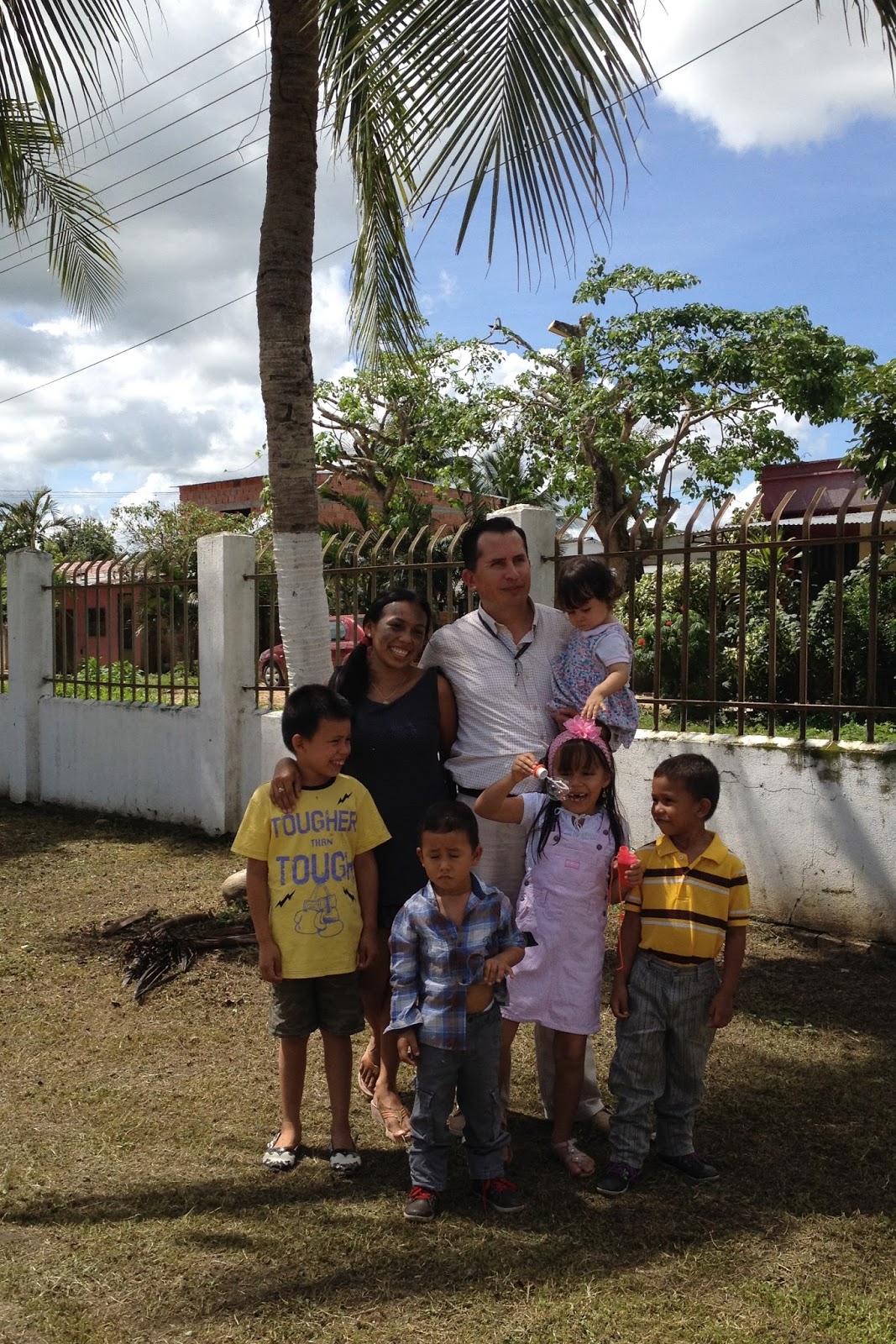
Pastor Edwin and his family, his wife, Diana, (children tallest to shortest) Daniel, age 8, Ana-Bella, age 7, Jesus, age 5, Mamu, age 3, and Cristal, age 18 months. (Photo credit - Katie)
Right before we left, as a thank you gift to us, Pastor Edwin presented everyone in our group with a poncho. These are typically warn in the warmer regions of Colombia. These were handmade by a member in the congregation.
Our group (left to right): Ida Oliveria, Adi Martinez, Pastor Atahualpa Hernandez, me (photo credit: Pastor Edwin Toledo)

Thursday, June 18, 2015

Our Reconciling Commitment

In a workshop this past Saturday, the 13th of June, in the city of Bucaramanga, as we talked about the role of the church in working toward reconciliation, we were all grateful for the humbling presence of children. Two thirteen year boys and a ten year old girl participated, actively and profoundly, in our conversations.

The conversations started with everyone sharing how they define the term reconciliation, how they understand what the word means. Lizeth Toloza, the ten year old girl, offered her definition early on. She explained that she understood reconciliation as a process, not as an event, that we must always be working towards to build it or to safe-keep it; that this process of reconciliation is very fragile and is in need of constant upkeep.

Lizeth Toloza (10 years old) sharing her understanding of what reconciliation is. (photo by Jenny Neme)
This set the stage for how our group would continue to discuss the concept of reconciliation; looking towards those processes that the church can support or initiate. Continuing with the active and deep participation of these children, their perspectives along with their “beyond their years” wisdom became integral to the entire workshop.
Lorena Lemus (speaking, 17 years old), and Samuel Romero (placing his paper on the board, 13 years old) explaining what we can learn about reconciliation from the story of Jacob and Esau (Genesis 25-33). (photo by Jenny Neme)
Anyellot Aparicio and Jose Antonio acting out the parts of peace and forgiveness, as components of reconciliation. (photo by Curtis Kline)
These inter-generational activities and conversations held throughout the workshop dealt with processes of reconciliation at levels from the personal to the church, and from the community to the nation. The participants brainstormed the creative and the practical and even dreamt of the seemingly impossible ways to defend, promote and respect the reconciling work of the church in the world.

Emperatriz Carujal explaining her thoughts on how to get involved in processes of reconciliation. On the board behind her are columns of: personal, family, church, community and nation, as levels of reconciliation. The many pages under each column showcase the creativity and commitment of the group, as well as the deep desire to work towards reconciliation in a country that has experienced more than 50 years of armed conflict. (photo by Jenny Neme) 
I look forward to continue these workshops about reconciliation. There remain two more planned for this year, one in Paz de Ariporo and the other in Sogamoso. We have already completed two, one in Bogota and this one in Bucaramanga. They have been inspirational and encouraging.